
The Autonomous Revenue Machine
Engineering the 100-to-1 Company

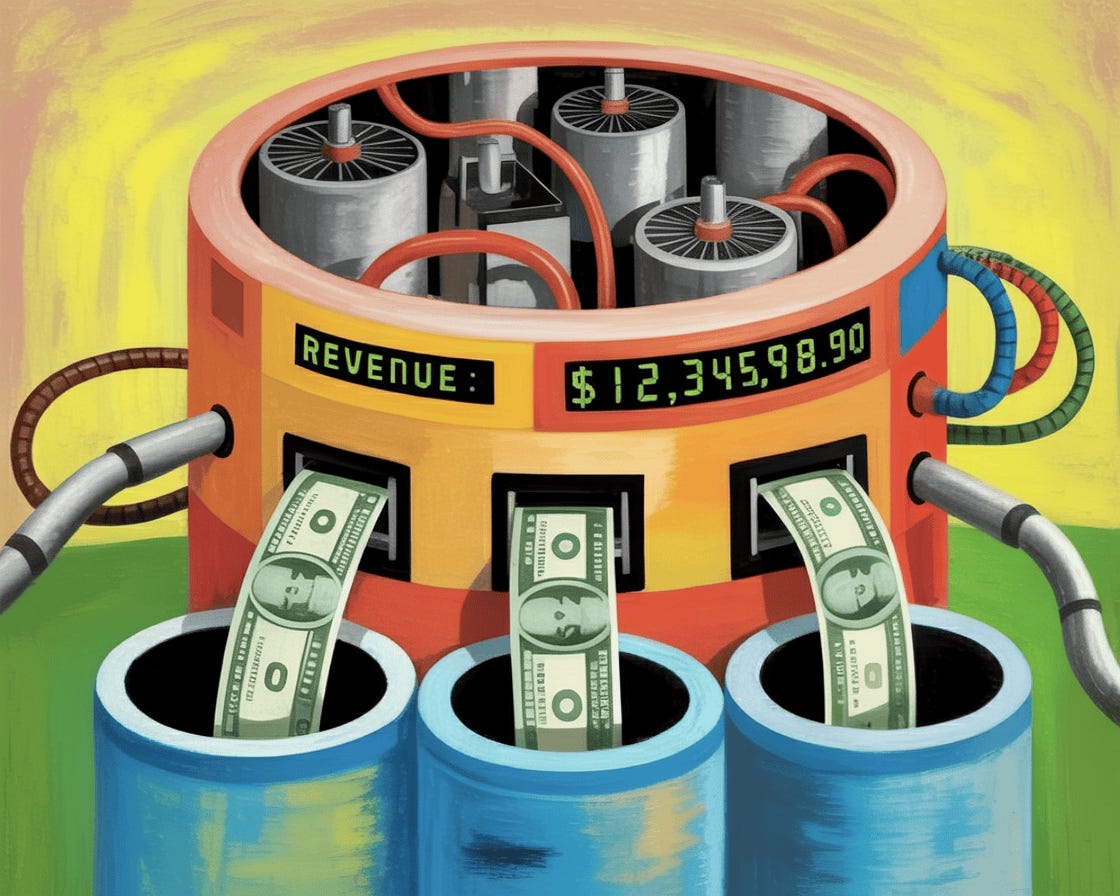
Fundamentally, a business is nothing more than a machine engineered to generate revenue. You put resources in one end, the gears turn, and you pump out value for customers at the other end. In a perfect system, this is a virtuous cycle of pure efficiency.
For thirty years, I have watched the startup ecosystem sell founders a lie.
The lie is that the only way to scale a technology company is to wrap it in a massive, inefficient layer of humans. We tell founders to raise millions of dollars and immediately spend it to hire armies of salespeople to explain value, marketing people to generate attention, and customer success people to apologize for confusion.
The founder calls this “building an organization.” I call it evidence of product failure.
We have been conditioned to believe that silos are necessary for scale. But in the modern digital economy, the traditional Marketing, Sales, and Service silos are not pillars of strength. They are Biological Scaffolding.
They are a temporary, expensive, and fragile human infrastructure erected to support a product that cannot stand on its own. And it is time to take the scaffolding down.
The Org Chart is a Confession
If you want to know where a product is broken, don’t look at the JIRA tickets. Look at the P&L. Look at the organizational chart.
Your org chart is a confession. It reveals exactly where the product logic is failing.
The Attraction Failure (Marketing): If you require a separate department to create “brand awareness,” your product lacks inherent virality or utility. You are paying a “mediocrity tax” to manufacture attention because the product isn’t interesting enough to generate its own news cycle.
The Transaction Failure (Sales): “High-Touch” sales is usually a euphemism for “Low-Clarity” value. If a human is required to navigate the transaction or explain the value proposition, the product is creating friction. If you need a human to negotiate the price, your pricing model is dishonest.
The Complexity Failure (Service): A large Customer Success team is a tax you pay for bad design. If a user needs onboarding, training, or troubleshooting, the product logic is flawed. “Customer Success” is often just an apology department for a difficult product.
This brings us to the central tenet of this essay, the Ruthless Thesis:
“Any aspect of your company that is not expressed through the product is a bug, not a feature.”
This is not a cute line for an all-hands deck. It is an architectural razor. It forces every team to justify its existence not by how busy it is, but by whether it is truly necessary–and if it is necessary, why that necessity hasn’t been encoded into the software yet.
The Physics of Scale: Finite vs. Infinite Labor
Why does this matter to the investor? Why does this matter to the Board?
It comes down to the physics of business efficiency. We must distinguish between Finite Labor and Infinite Labor.
Finite Labor is human effort. It is expensive, inconsistent, and linear. If you want to make 1,000 sales calls, you need 1,000 units of human time. If you want to scale revenue in a human-heavy model, you must scale headcount linearly. This destroys operating leverage. It creates a business that is heavy, slow, and prone to churn.
Infinite Labor is software. It is asymptotic. Once you write the code for a “Share” button or an automated onboarding flow, the cost to execute that function once is roughly the same as the cost to execute it a million times. It offers near-zero marginal cost of reproduction and perfect consistency.
The job of the modern founder is to systematically hunt down every instance where the company is using Finite Labor to solve an Infinite problem.
The Sales Demo: Is this a bespoke consultation (Finite), or a repetitive explanation of features (Infinite)? If it’s the latter, encode it.
The Onboarding Call: Is this strategic alignment (Finite), or a “click here, then click there” tutorial (Infinite)? If it’s the latter, encode it.
We are not firing humans to save money; we are firing them from robot work so they can do human work. We are moving from a model of “People-Heavy” to Product-Integrated.
The 100:1 Company
This shift in architecture creates a bifurcation in the market.
On one side, we have the Legacy Incumbent. To generate $1 Billion in revenue, they employ 5,000 people. They are buried under real estate costs, management overhead, and coordination drag. Their Human Dependence Index (HDI)–the cost of human labor per dollar of revenue–is massive.
On the other side, we see the rise of the 100:1 Company.
This company generates $100 million with 10 employees, or $1 Billion with 100. They achieve this because they have zero “GTM Headcount”.
No Sales Team: The product negotiates contracts via logic gates.
No Support Team: The product self-heals and self-explains.
Minimal Marketing: The product generates its own distribution loops.
When the 100:1 company competes with the 5,000:1 incumbent, the math is brutal. The 100:1 company has 95% gross margins. They can undercut the incumbent on price by 50% and still be more profitable. They can iterate ten times faster because they don’t have to retrain a sales force on every new feature.
The Choice
You have a choice. You can build a services firm with a software multiple–a company that scales linearly, fights constant churn, and watches margins erode as headcount balloons.
Or, you can build an Autonomous Revenue Machine. You can accept the difficult engineering challenge of encoding the GTM motion into the software. You can suffer the short-term pain of building the “Complete Product” in exchange for the long-term gain of Infinite Labor.
The market is ruthless. It eventually punishes the inefficient. The “Human-Heavy” model is a relic of an era where distribution was physical and software was dumb.
That era is over. The product is the company. Everything else is just scaffolding.