
The Discipline Beneath the Funnel
Why execution, not ideas, is the real advantage in modern revenue leadership

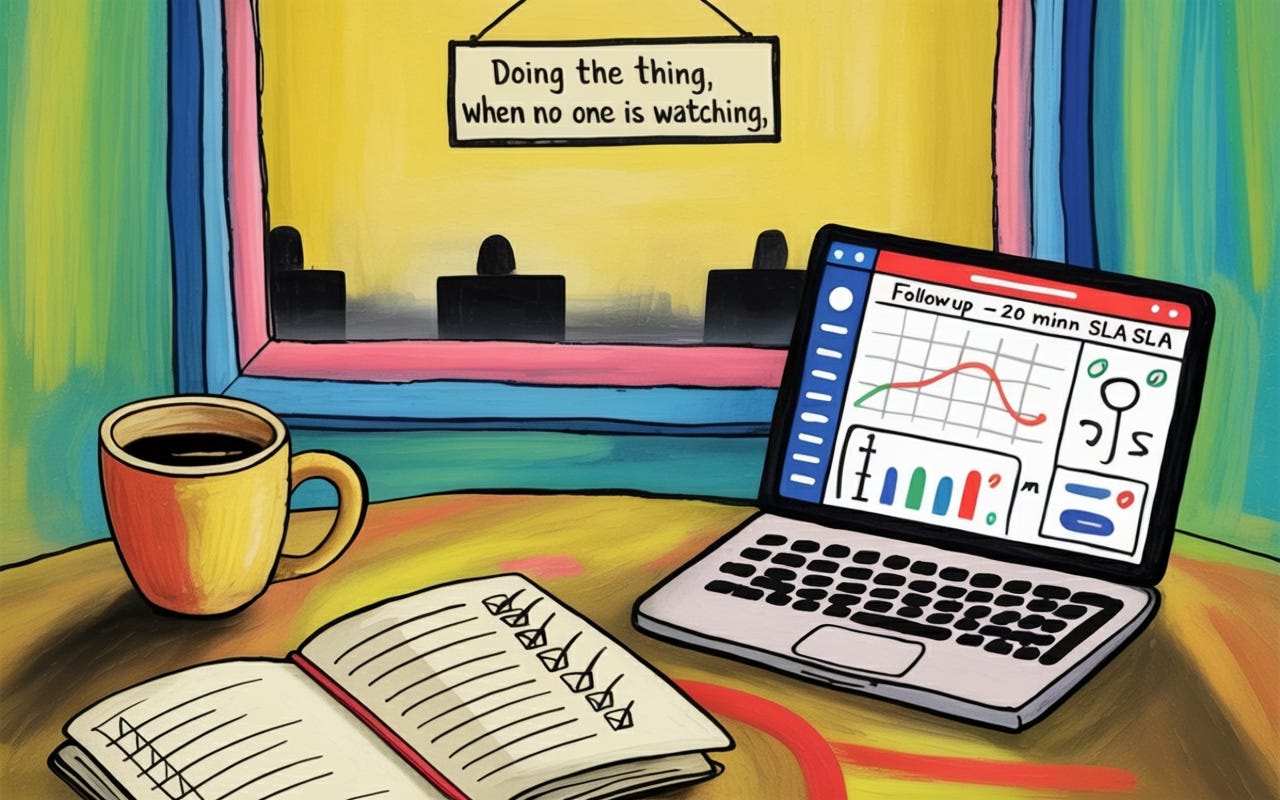
There is a quiet conviction I have been carrying in the latter half of my career, and it is this: ideas are the cheapest thing in any room I walk into. They arrive unbidden, they accumulate in decks, they pile up in offsites where leaders nod gravely and then go back to their desks unchanged. What is rare — what is, in fact, almost geological in its slowness to form — is execution. Not execution as a single feat, but as a habit. The capacity to do the right thing not once, in a fit of inspiration, but hundreds of times, on a Tuesday, when no one is watching.
I came up through product and brand. For twenty-odd years I sat in rooms with designers and writers and researchers, arguing about a single word in a tagline, redrawing a navigation flow because the second click felt half a beat too slow, defending a launch story against the hundred small compromises that quietly drain a product of its meaning. That training shaped me in ways I am still discovering. It taught me, above all, that a brand is not a logo and a product is not a feature list. Both are promises. And a promise that the organization cannot operationally keep is not a brand at all; it is a debt, accruing interest in the form of churn and quiet disappointment.
That conviction is what eventually pulled me into operating roles. I noticed that the product and brand leaders who were treated as oracles were not the ones with the most beautiful decks; they were the ones who could trace a creative choice all the way down to a number on a P&L and defend it without flinching. So I made that my posture. I learned to read cohort charts the way I had once read storyboards. I learned to partner with analysts and data scientists the way I had once partnered with illustrators — with respect for a craft that was not mine, and with a refusal to outsource the consequences of their findings. The math was theirs. The accountability became ours, together.
The first thing I did when I stepped into broader leadership was to dismantle a metric. The marketing-qualified lead, the MQL, has been the scaffolding of B2B for two decades, and it deserves a respectful burial. A single human raising a hand on a single form is a poor proxy for what actually happens when a company decides to buy enterprise software. It treats a moment of revealed interest as if it were the relationship itself. The truth is messier and more humbling: a buying group of ten or twelve people, hundreds of anonymous touches, a long preference for peer conversations over sales calls, and a vendor shortlist that is already drawn up in eight out of ten cases before anyone fills out a contact form. If that is the world we live in, then chasing leads is like fishing for a school with a single hook.
So we built our metrics around the account, not the lead. We watched which target accounts were lighting up with research intent, how deeply we had penetrated the buying group inside each one, how quickly accounts moved between journey stages, and which combinations of campaigns they touched on the way. None of this was first-touch or last-touch attribution. Attribution debates, in my experience, are theological. They produce heat and very little light. What we wanted was a picture of the whole orchestra, not a credit line for the violinist — and as someone who grew up writing the score, I found that picture infinitely more honest about what was actually happening on stage.
The second thing I did was to refuse the false economy of cutting brand to fund demand. This is the fight I was born for. Every difficult quarter, the same temptation arrives, dressed as prudence: pull the brand spend, ship more bottom-funnel offers, hit the number. I have watched companies do this for years on end and then wonder, plaintively, why their customer acquisition costs keep climbing and their selling prices keep slipping. Strong brands command premium pricing and lower the cost of every deal that comes after them. That is not a feeling I picked up along the way; it is a finding, repeatedly demonstrated, that the people I came up with happened to know in their bones long before the spreadsheets caught up. So I designed campaigns as full-funnel architectures from the outset, with something to offer the prospect who is not yet ready to register for anything, and I defended brand investment to my CFO with the only language a CFO trusts: efficiency ratios, share of voice, ICP movement from no intent to early intent, the unsexy growth of direct and organic traffic. If you cannot translate your art into arithmetic, you will lose the budget for the art.
The third thing — and this is the part most companies get wrong — was to operationalize all of it. An idea, once again, is nothing. A framework on a wall is nothing. A beautifully art-directed campaign that no one routes, scores, or follows up on within a credible window is nothing. What matters is the management operating rhythm: the weekly meeting, where marketing, sales, customer success, and revenue operations stares at the same live dashboard, in the same color-coded reality, with the same single pipeline goal. Not marketing-sourced versus sales-sourced. One number. One scoreboard. When the early-stage pipeline sagged, marketing stepped in. When closing slowed, sales did. The internal accounting that pits revenue functions against one another is one of the most expensive forms of theater a company can stage, and I have stopped paying for tickets.
Beneath that rhythm, we set behavioral SLAs that were almost monastic in their specificity. Twenty minutes from a qualified-account trigger to the first meaningful sales activity. Three personas engaged within the buying group before the account moved on. Six minutes to respond to an inbound hand-raiser, because inbound intent decays like a half-life. I have seen response times improve by a factor of four within a quarter simply because the dashboard was visible and the expectation was unambiguous. Inspection is not surveillance. Inspection is care.
And then there is the question that hovers over everything now: what does artificial intelligence do to the discipline I have just described? My answer, which I offer without triumphalism, is that it deepens it. AI is a forcing function for the kind of unified data, unified messaging, unified customer journey that I have been advocating for years. The companies that will sound homogenous in the new era are the ones that bolt point solutions onto point solutions and let each one generate copy in its own voice. The companies that will sound like themselves are the ones that consolidate, that train their models on a coherent corpus of who they are, and that insist on a human soul threaded through the automated output. This is, in the end, a brand problem wearing a technical costume.
So I come back, always, to execution. Not as a slogan, not as the bullet point at the end of a strategy deck, but as the actual texture of the work. Execution is the weekly meeting that no one cancels even when the quarter is going well. It is the dashboard that no one is allowed to maintain a private version of. It is the twenty-minute SLA honored at 4:50 on a Friday afternoon. It is the brand campaign that gets defended, in the same breath, with a creative argument and an efficiency ratio. It is the buying group treated as a buying group rather than a list of leads, even when treating it that way takes longer and pays back later. None of this is glamorous. None of it photographs well. But it is what separates the companies whose strategies survive contact with reality from the companies whose strategies are reread, two years later, with a quiet wince. Ideas are easy. Plans are easy. What I have spent a career learning, and what I will spend the rest of it teaching, is the small, repeatable, almost boring discipline of actually doing the thing — every day, on every account, in every meeting, until doing it becomes the only way the organization knows how to operate. That is the discipline beneath the funnel. Everything else is decoration.