
The End of Fortress Marketing
Switching costs, proprietary tech, and data advantages are fading. What remains is taste, speed, and point of view.

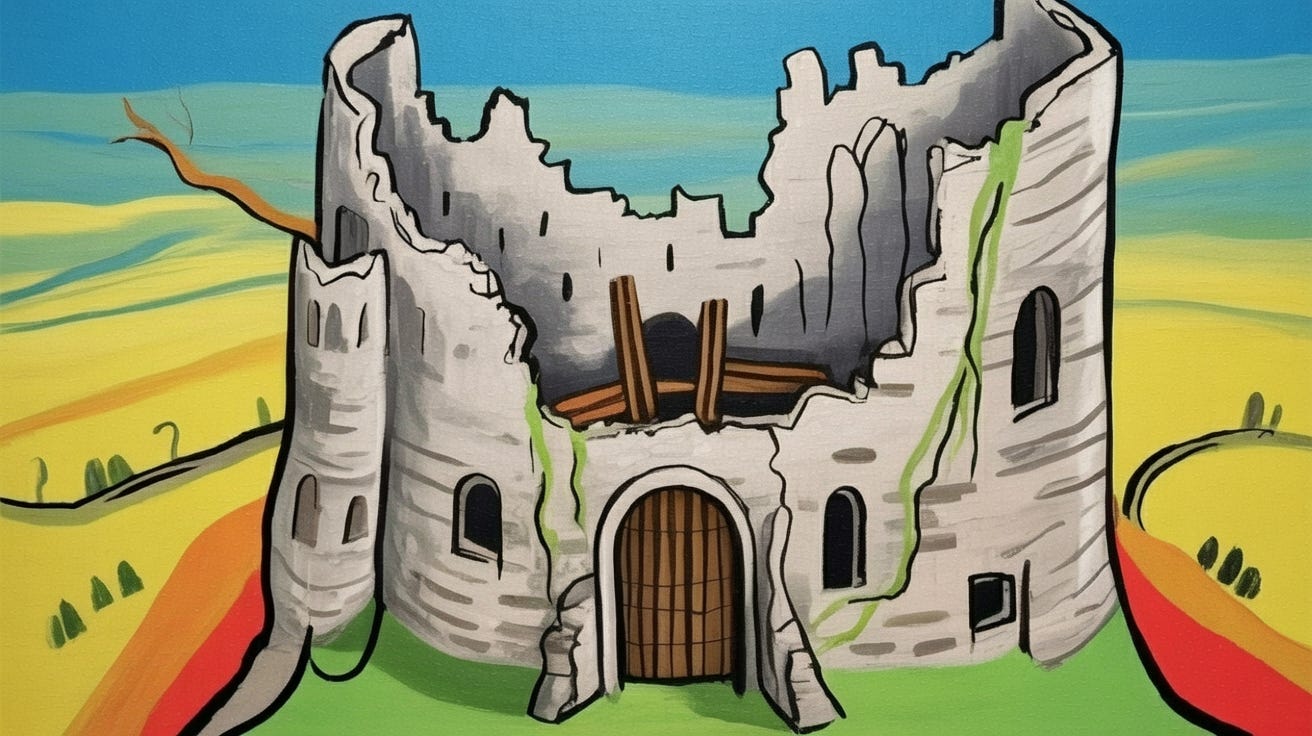
The old playbook had a comforting shape. You found an underserved segment, spent eighteen months building something proprietary, locked customers into multi-year contracts, and let switching costs do the rest. Defensibility was a thing you could point to on a slide: years of engineering, a data advantage nobody could clone, an installed base too heavy to move. Marketing’s job was to narrate that fortress and price the rent.
That fortress is rubble. A product that ships Monday gets cloned by Wednesday because the hard part of building it has collapsed into a weekend of prompting against a frontier model. The technical lead that used to last years now buys you a few months, sometimes weeks. Cursor reportedly crossed $100 million in annual recurring revenue in roughly a year, and a dozen credible competitors showed up while it was still working out its own onboarding. Once the product stops being the moat, every assumption GTM was built on needs a second look, starting with the most flattering one, that a great product markets itself.
So the real question for whoever owns marketing now is what’s actually left to defend. The honest answer is uncomfortable, because it sounds like the soft stuff we spent a decade learning to distrust. Two things are left standing: taste and velocity. Not the product, not the data, not the contract. The feel of the thing and how fast you can make the next one. That changes what positioning, category work, and demand gen are even for.
Taste is the cover charge
When the technical differentiators dissolve, everyone reaches for the same word. Taste. If the models are commoditized, the argument goes, then judgment becomes the moat: the aesthetic sense, the editorial restraint, the instinct for what’s right that a machine can’t fake. It’s a flattering story for people who do positioning for a living, which is precisely why I distrust it.
Paul Graham made the observation that undercuts it in an essay about why he likes Swiss watches. Good design is centripetal. It pulls everyone toward the same right answer. When most people have bad judgment, the one operator with taste looks like a genius. But taste isn’t a secret. It’s a skill, and skills diffuse. The tools that bake in good defaults are in everyone’s hands now, the patterns are written down, and the median product in any category gets better-looking every quarter. The field converges.
Which does something specific to your positioning. Taste stops being a differentiator and becomes the price of admission. A product that feels clunky is dead before the first demo. A product that feels great no longer wins on feel because the other three vendors in the bake-off feel great too. Linear is the example everyone cites, and it cuts both ways: its design didn’t just lift Linear, it reset what every buyer in project management now expects on day one, which means Linear’s own polish bought it less room than the case studies imply. When everyone at the table has taste, taste gets you to the table. That’s all it does. The deck that opens with “beautifully designed” is describing the floor and calling it the ceiling.
Velocity is the engine
If taste only gets you in the room, velocity is what keeps you there. Not launch-week speed. The kind that compounds.
The fashion creative director is the comparison most people reach for. They invoke it to mean “have a vision.” The actual lesson is that it’s one of the most precarious jobs in business. Houses burn through creative directors with a brutality that has nothing to do with talent because talent was never the question. The question is whether you can deliver the next collection on time, before the room’s attention drifts. Nobody’s grading the show that just closed. They’re grading the market’s belief that the next one will be good.
Software runs on that same clock now, only compressed. The investor Elad Gil has put it plainly: in AI, a feature lead that once meant years means a quarter. Build one excellent thing, try to harvest it for a decade, and you’ll watch the harvest get cloned before the renewal lands. Velocity is the operational and cultural muscle to keep shipping reinventions while the last one is still getting applause. Feeling the market move, deciding what’s next, getting it out the door before the feeling goes stale.
For GTM that’s structural, not a matter of tempo. A launch motion designed to fire twice a year can’t carry a product that changes in meaningful ways every six weeks. The messaging has to be re-derived as fast as the product moves, which means the positioning is never finished, and the category story underneath it has to be sturdy enough to survive constant churn in the feature set above it. The teams winning here run marketing like a collection, not a campaign. New drop, new beat, same point of view. For twenty years the hard part was building. Now it’s not stopping.
Brand is real. The ground under it isn’t.
The Swiss watch story is the one the luxury crowd loves, and it’s worth telling straight, because the ending always gets dropped. It ran in three acts over about forty years. First, engineering merit, when a Swiss movement was simply the most accurate way to know the time. Then the quartz crisis, when cheap Japanese quartz made accuracy a commodity and gutted the function the whole industry sold. Then the brand age, when the survivors stopped selling timekeeping and started selling status, heritage, the object on your wrist.
Software is running the same three acts at ten times the speed. A product launches with a genuine technical edge. Improving models commoditize that edge inside a quarter. And it’s shoved, fast, into competing on experience and feel and brand, the same pivot the watchmakers took a full generation to make. The optimistic reading of that arc stops at act three: build a brand, reach the harbor, charge the premium forever.
The harbor isn’t safe, though. A brand is only as durable as the ground it stands on, and the Swiss watch brand age held right up until the Apple Watch colonized the wrist. The threat was never a rival watchmaker with cleverer branding. It was a different device that reset the whole stack and erased the distinction the brand existed to signal. In AI, the ground never stops moving. The model under you, the interface, the device, and the basic shape of the interaction, any of them can reset inside the life of a single company. A brand built on one interaction pattern goes stale the day that pattern changes. The luxury comparison leaves this part out because luxury, for a long stretch, got to stand still. You don’t get that.
What’s actually left
Taste is the cover charge. Velocity is the engine. Brand is shelter on ground that won’t hold still. What compounds underneath all three is harder to name and harder to copy: the instinct for finding the next real problem before anyone’s paying you to.
The operators who last won’t be the ones with the most refined taste or the loudest demand-gen machine. They’ll be the ones who get restless with their own wins, who can smell the commoditization coming for their own product before the market prices it in, who are already chasing the next genuine customer need while the current one is still on the board. That sits upstream of every positioning exercise you’ll ever run. You can’t position your way out of a problem that’s stopped mattering to anyone.
There’s a real irony in here for those of us who build brands for a living. The way to build one that lasts is to stay willing to walk away from it. You protect a brand age by refusing to get comfortable in it. So the move isn’t to cosplay the creative director’s taste. It’s to build a GTM org that can survive the creative director’s actual job: own as much of your own infrastructure and distribution as you can, treat every product and every campaign as this season’s collection rather than a monument, and keep your judgment pointed at hard customer problems instead of at curating how the last answer looks.
From the cheap seats, the company that wins the next decade will look like a luxury house. Impeccable taste, frightening pace, a point of view people pay just to stand near. Up close it’s less glamorous than that. It’s a room full of people who’ve made their peace with the fact that nothing they ship gets to be permanent and who’ve stopped wishing it would.