
The Three Myths of Product-Led Growth
Why your "product-led" strategy is actually just a sales team in hiding.

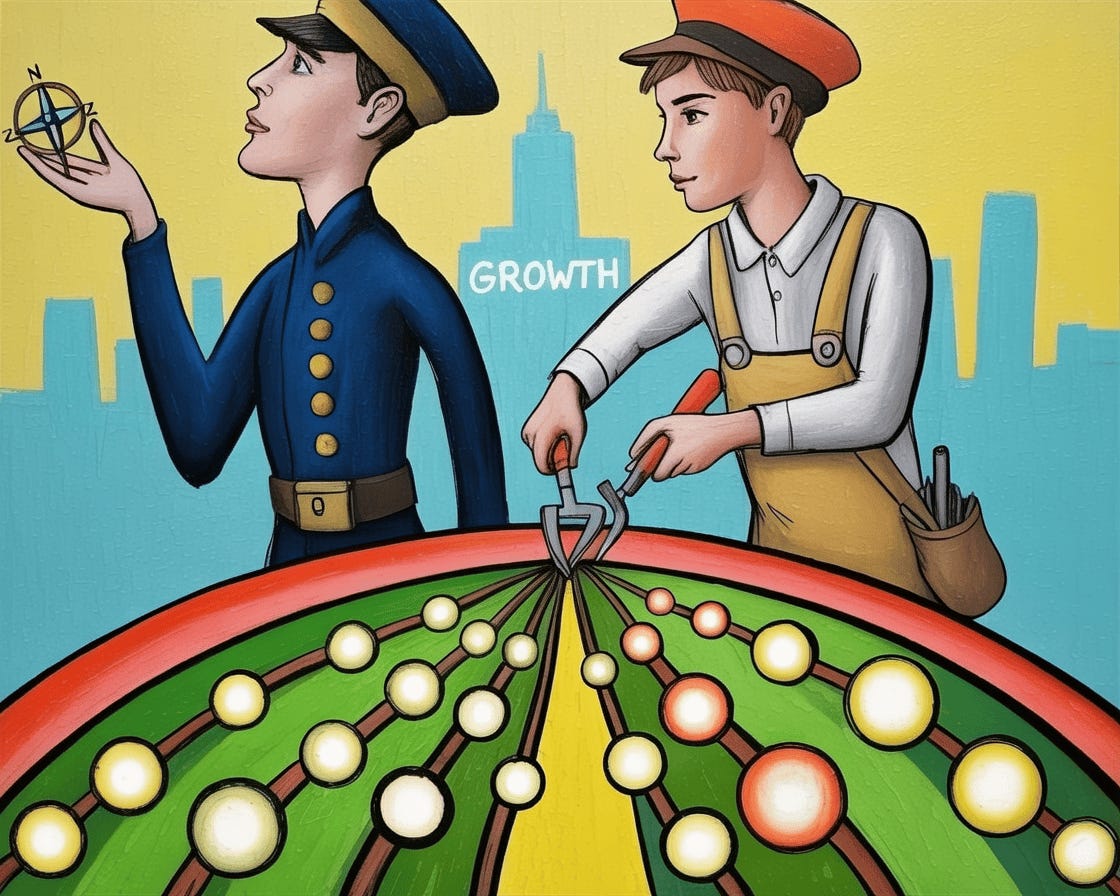
In venture-backed tech, words are the first thing to get vaporized by hype. When a concept picks up momentum—”Cloud,” “Big Data,” “AI”—marketing bodies swarm around it like bees, and by the time they are done, it means everything and nothing.
One of the current sacrificial lambs is “Product-Led.”
Stroll into any B2B SaaS founder’s pitch, and you are bound to hear some variation of: “We’re product-led.” Then they gesture proudly at an org chart that includes a 50-person sales army and a CAC payback period of 18 months.
Nice story. False advertising.
We are in a taxonomy crisis. We are using the same words to describe wildly different business mechanics. We have confused marketing tactics (free trials, viral loops, clever splash pages) with existential states (a product that actually sells itself).
That sloppiness is expensive. It creates what I call the Mullet Company: classy product in the front, cash-burn party in the back.
Before I show you the cure—the Product-Integrated Company—we need to debunk the three myths that let companies hide behind “product-led” lip service. These half-measures are the reason so many firms remain dependent on the Biological Scaffolding we dismantled in Chapter 1.
Myth #1: The “Product-First” Fallacy (The Artisan Trap)
The first myth is the most innocent, born of good intentions and an engineer’s idealism. This is the Product-First Company.
The Product-First company is usually founded by technical visionaries who deeply value code quality, design elegance, and user experience. Their philosophy is the “Field of Dreams” strategy: If we build it, they will come.
In these organizations, the Product team is the “crown jewel.” They are the rock stars. They are protected from the messy realities of the market. The founders believe that because their widget is technically superior (faster, cleaner, more robust), it will inevitably win the market .
The Fatal Flaw: They build a Ferrari engine, but they put it inside a horse-drawn carriage.
Because they view “Sales” and “Marketing” as separate, somewhat distasteful activities that must be tolerated, they hire mercenaries to handle them. They bring in a “coin-operated” VP of Sales and tell them: “We built this amazing thing. Now go sell it.”
This creates a massive disconnect. The product is built in a vacuum, often disconnected from the commercial reality of how customers actually buy. The sales team, unable to explain the nuanced brilliance of the engineering, resorts to brute-force tactics: steak dinners, relationship selling, and discount levers.
The Product-First company is a “Human-Heavy” organization selling a premium digital good. They have not encoded the sales motion into the product; they have simply handed a better tool to the same old expensive humans.
Myth #2: The “Product-Led Growth” Delusion (The Front-Door Trap)
If Product-First is the trap of the idealist, Product-Led Growth (PLG) is the trap of the tactician.
PLG is the buzzword of the decade. The central promise is seductive: let the user try the product before they buy it. Put a “Free Trial” or “Freemium” button on the website. Let the product do the prospecting.
On the surface, this sounds like the solution we are advocating for. But in 90% of implementations, PLG is not a business strategy; it is a lead generation hack.
The Fatal Flaw: They optimize the front door, but the house is still full of manual labor.
Most companies treat PLG strictly as a “Top of Funnel” activity. They engineer a frictionless sign-up flow and a slick first-run experience. They successfully get the user into the product without a human.
But what happens next?
The moment the user hits a snag? “Contact Support.”
The moment the user wants to upgrade to an Enterprise plan? “Contact Sales.”
The moment the user needs to integrate with their security stack? “Assigned a Customer Success Manager.”
The PLG company has automated Acquisition, but it has left Expansion, Retention, and Support to the humans.
This creates a terrifying operational bottleneck. Because PLG opens the floodgates to thousands of low-value users, the noise in the system explodes. Support tickets skyrocket. The sales team drowns in “leads” that are really just curious teenagers. To cope, the company hires more support reps and more SDRs to filter the noise.
Suddenly, the efficiency gains of the “product-led” motion are eaten alive by the cost of servicing the volume it created.
Myth #3: The “Product-Led Company” (The Hybrid Hell)
The third myth is the most dangerous because it looks the most like success. This is the Product-Led Company (as distinct from PLG).
In this model, the company genuinely tries to give the product a seat at the table. The Product team influences marketing messaging and collaborates with sales on the roadmap. They aren’t just building features; they are trying to drive business outcomes.
The Fatal Flaw: They try to run two operating systems simultaneously.
Operating System A: The traditional sales-led motion (High-Touch, Human-Centric, Relationship-Based).
Operating System B: The product-led motion (Low-Touch, Data-Centric, Automation-Based).
The result is Hybrid Hell. It is an internal civil war. The Sales VP fights for “sales enablement features” (custom reports, admin controls) to close the whale accounts. The Product VP fights for “usability features” (self-serve onboarding, viral loops) to drive the high-velocity motion.
Because the company refuses to fully commit to the machine—refuses to view the product as the only truth—they end up with a compromised architecture. They build a product that is too complex for self-service but not customizable enough for the enterprise.
The True Architecture: The Product-Integrated Company
To escape these myths, we must stop trying to make our silos work better together. We must dissolve the silos into the software.
We need a new category: The Product-Integrated Company (PIC).
A Product-Integrated Company is an organization where every critical customer function—acquisition, activation, retention, expansion—is expressed through, encoded into, or automated by the product itself.
In a PIC, the product isn’t a thing the company ships; the company is the thing the product runs.
Product-First focuses on the quality of the tool.
PLG focuses on the entry point of the tool.
Product-Integrated focuses on the entire lifecycle of the customer being managed by the tool.
The fundamental distinction is how they scale.
Traditional Models scale by Headcount Addition (Linear). Want 2x revenue? Hire 2x sales reps.
PIC Model scales by Software Compounding (Asymptotic). Want 2x revenue? Tune the algorithms, polish the funnel.
The Diagnostic: The Friday Afternoon Test
How do you know which one you are? You cannot rely on your mission statement. You must perform a thought experiment I call The Friday Afternoon Test.
Imagine that at 5:00 PM on Friday, you fire your entire Marketing, Sales, and Customer Success departments. You lock the doors. On Monday morning, the only things running are your servers and your code.
In a Product-First Company: New revenue drops to zero immediately. No one is there to explain the genius of the code.
In a PLG Company: Sign-ups continue, but conversion to paid stalls because no one is there to catch the leads. Churn spikes as support tickets go unanswered.
In an Autonomous Revenue Machine Company: The revenue continues to flow.
The product generates its own traffic through viral loops (Marketing).
The product onboards new users through interactive tutorials (Service).
The product identifies high-value usage and unlocks enterprise features via automated contracts (Sales).
In this company, the humans are gone, but the machine is still growing.
This is not science fiction. This is the reality of Atlassian, of Zoom, and of Slack in their early days. They had a good product or a free trial, but they also had something else. They had a radically different architecture. They had an Autonomous Revenue Machine.